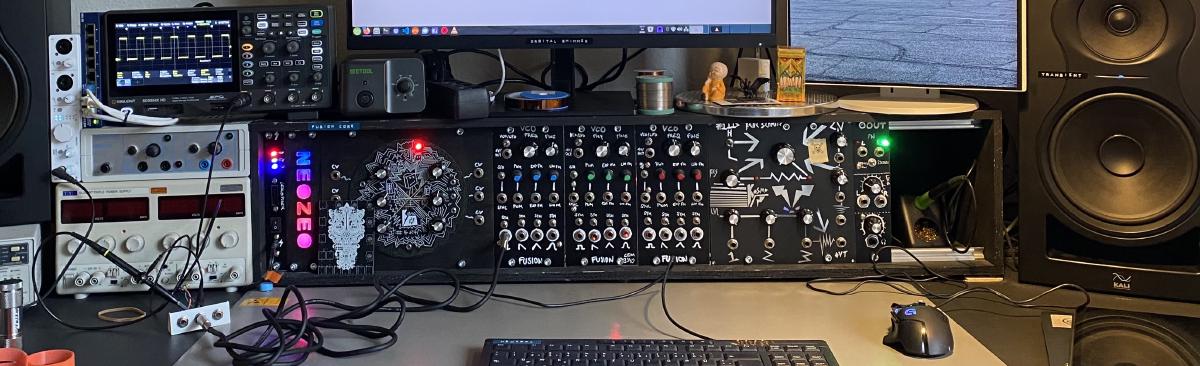
Hi!
Since February 2024, I am working on an analog, modular synthesizer, which I call “FUSION CORE”. In the picture above, it is the big black box below the screens and the biggest project yet! I use it as a playground for analog circuit design with the goal of doing live hypnotic techno on it later on.
What is a synthesizer? #
In comparison to a traditional instrument like a violin, synthesizers use electronics to generate sound. In a violin, the sound is defined by the physics of the wooden body and the strings, in a synthesizer, it is an electronic circuit or a computer program that produces a sound signal that can be listened with a speaker.
Synthesizers, or in short synths can be found in the wild with a lot of different shapes:


Why bother with synthesizers? #
Although a violin player has ways to shape the sound using different violin bow movement techniques and his fingers on the fingerboard, the options for sound shaping are still limited - you cannot let a violin sound like a clarinet! Or like a car driving by. You cannot make a techno beat with a violin!
That’s the task of a synthesizer – a synthesizer enables sound design with a much bigger freedom than a traditional instrument. Either, a low level electronic circuit has a voltage in it that oscillates or a computer program calculates it. With them, you can generate tones and melodies that can sound like everything you imagine: Beats, water drops hitting ground, the action of shoveling earth, giant spaceships going over the head and more - here are some random examples from my Arturia Microfreak synthesizer:

Analog vs. digital synthesizers #
An analog synthesizer uses basic electronic phenomena to generate sound signals. It uses concepts like charging capacitors, using single transistors and operational amplifiers to generate an oscillating voltage. Now, when connecting a speaker to it, the voltage directly moves the speaker membrane and thus creates sound.
Thus, it doesn’t work with 1s and 0s, rather with values in between. With a screwdriver, one has to adjust variable resistors to tune the frequencies, and one has to deal with the circuit changing its behavior with temperature (often, tones become higher). It is quite complicated to develop and sometimes can sound a little dirty.
Digital synths are mostly used nowadays and use computer logic that digitalize the signal by sampling the signal at a specific sampling rate (like 48,000 Hz) and with a given resolution (like 24 bits). Every position of the speaker membrane is calculated by computer logic at speeds that we can listen to. They are more precise, cheaper, and can be scaled up to make more complex systems.
Why do you need to build an analog, modular synthesizer? #
I love electronic music. A lot of music pieces spawn images of landscapes in my brain, shaped by the sound design of the synths. In attachment 1, I describe some of these landscapes. Building my own synthesizer from scratch gives me full freedom in the sound design and thus shape my own landscapes!
Now, why analog? I find it very fascinating, that simple, independent components inside an electric circuit create a sound when being connected. Circuits exploit physical laws to do magic things! Designing my own synth allows me to slowly develop skills how to do magical things.
Also, I think, the dirtiness gives the synth more character. Mistakes in circuit design will result in very specific sound quirks making my synth unique.
And why modular? Having all the functionalities in the synth being split up onto different, reconfigurable modules, gives the maximum freedom possible!
Non-modular synth
Modular synth
My background #
Alongside school, I had a 9-year education in playing the clarinet, both solo and orchestra (also in Hamburg’s Elbphilharmonie). Music therefore was a central part of my life. However, I became interested in electronics, started tinkering with Arduinos and programming games. With my new background in my computer science in engineering at university, I realized I could combine both worlds!
Getting Started & Resources #
A good friend of mine recommended the YouTube channel Look Mum no Computer. LMNC is both an artist and engineer and builds the synthesizers himself. In his practical, no-fear approach, he started my interest. In one of his videos, he explains building a whole, simple analog synthesizer on two breadboards. That made me feel, oh, that’s actually do-able! So I started!
If you are interested, there are several resources out there, most of them for free! I recommend starting out with some YouTube tutorials from Look Mum No Computer and playing with the virtual modular synth “VCV Rack” (see below). If it drags you into the rabbit hole, then you could start with some circuits. Don’t do too many plans and avoid being overwhelmed by too much literature / theoretical plans :).
People on YouTube, great for inspiration #
- Look Mum No Computer: With his enthusiasm and his characteristic sentence “don’t be scared to try it”, he gave me a lot of motivation to try it out myself!
- Omri Cohen: It is not easy to start with modular synthesizers, however he does many great tutorials in the virtual synthesizer program “VCV Rack”. VCV Rack is a great tool since one can try out a lot of different modules, make whole pieces, and it’s for free!
- DIY Modular Sessions See what’s possible with DIY analog modular synths!
- Moritz Klein: Already pretty technical, high quality tutorials, but explained from the ground up! Nice visuals and entertaining.
- Lauri’s DIY Channel TV Another creative channel on DIY electronic instruments!
Books #
Good for basic background knowledge. I didn’t read those from start to finish, but by jumping from chapter to chapter. Also staring at schematics again and again :)

Make: Analog Synthesizers
A hands-on guide to building your own analog synthesizer, covering the parts, schematics, and techniques musicians and hobbyists need.
This is from Ray Wilson, a famous guy inside the analog-diy-synthesizer community. It is the most helpful resource since it provides intro into different topics. Although being a small book and did not answer all questions, it both provides overview into every topic and also goes into detail. It also is a great starting point for further questions.

The Art of Electronics 3rd Edition
by Horowitz and Hill
For me, when dealing with individual components, like transistors or OpAmps, this book provided great center of knowledge. Sometimes, when I am free, I am browsing a little in it.

electronics Forrest Mims engineer
electronics Forrest Mims engineer
These summarize some useful, general circuitry in a nice format.
Look Mum No Computer Forum #

Look Mum No Computer Thingies
A Place For People Who Are Building Things Or Wanna Talk Stuff Related To Look Mum
When designing your first circuits, if you have some questions that aren’t answered in videos, then the LMNC-Forum is a nice community you can come to! You can ask detailed questions and present your progress. Before ordering my designed PCBs, it’s nice to get a little accompanying tips on the design and avoid obvious mistakes.
Further internet websites #
- Look Mum No Computer (Sam Bartle)
 www.lookmumnocomputer.com
STUFF - LOOK MUM NO COMPUTER
Click on the images for more info on the projects, this is a work in progress and will build on the pages as i go.
https://www.lookmumnocomputer.com/projects#/ - Eddy Bergman
 www.eddybergman.com
Eddy Bergman.com
A short introduction to KiCad 9.0 or 10.0 and step by step guide to making PCBs in KiCad. I go through the steps with you and tell you my learning …
https://www.eddybergman.com/ - Thomas Henry
 www.birthofasynth.com
Thomas Henry Designs
The Thomas Henry Designs are for personal use only and may not be published without permission of Thomas Henry or Scott Stites. This site copyright …
https://www.birthofasynth.com/Thomas_Henry/TH_main.html - Music from outer Space (Ray Wilson)
 musicfromouterspace.com
Music From Outer Space Your Synth-DIY Headquarters
From time to time, I'll share a story or two about Ray and his life and works, so you'll get to know him a little bit better through my musings.
https://musicfromouterspace.com/ - René Schmitz
 www.schmitzbits.de
Synth stuff
https://www.schmitzbits.de/index.html - Erica Synths
 www.ericasynths.lv
Home page - Erica Synths
An analog drum machine forged out of deep respect for traditional designs with innovative improvements and the combined spellwork of its makers.
https://www.ericasynths.lv/
Useful lectures in university #
These provided some basic understanding of circuits and signals:
- Electrical engineering I & II (Basic circuit theory)
- Signals & Systems
Progress so far #
As of today (2026-09-20), I am still developing the synth. My plan is to document my progress so far step by step in individual, upcoming articles in the following months. At the moment, I am developing a voltage controlled filter. I actually set up this blog to sort my thoughts on it and reflect on the results of my experiments.
Attachment 1: Landscapes, shaped by sound design #
When listening to music, my brain often imagines landscapes or scenes, defined by the sound design of the music, two examples here:
Mambo by Feral #

Mambo
Provided to YouTube by Triple Vision Record DistributionMambo · FeralCrossroads℗ 2022 Hypnus RecordsReleased on: 2022-11-08Auto-generated by YouTube.
If you listen to that, what do you imagine?
I think of an abandoned quay at night. There is no one out there, cloudy sky with the moon sometimes visible, sometimes not. The boats, hit by little waves in the black water, bump against the quay every now and then… It’s a pretty calm, ambience, but there is definitely something going on!
Sun Eater by Technical Itch #

Sun Eater
Provided to YouTube by The Orchard EnterprisesSun Eater · Technical ItchProgression Threat One℗ 2013 Technical Itch ProductionsReleased on: …
What do you think?
In my head, I am in the cold mountains. The mountains are high and snow and ice cover the ground and the tips of the mountains. The sun shines bright and cold and results in a lot of reflecting sparkles in the ice.
Now when the bass kicks in at first, something is going on. One cannot see anything, but one can feel something huge and massive walks through the mountains. The floor vibrates, a puddle on the ground has little waves on it.
When the beat arrives, one can see a big AT-AT from Star Wars walking slowly, but steadily into the scene. It is so huge that it doesn’t fit entirely on the view and its feet leave big craters behind.